
Elkhart County Arrest Records and Charges
An arrest record is the law-enforcement side of an event. It can involve the arresting agency, arrest date, booking number, jail custody status, holds, and release information. In Elkhart County, current county jail custody is searched through INjail Public Access, and sheriff records requests are handled by the Elkhart County Sheriff's Office records division.
A court charge record is different. Charges appear after a prosecutor files a charging document or after a citation becomes a court case. Elkhart County uses Indiana's Odyssey case management system, and public court charges can appear in Indiana MyCase with the case number, court, charge details, hearing history, bond entries, dispositions, and sentencing events when public. Use Elkhart County inmate records for the custody and booking side, and use Elkhart County criminal court records for the full case file and outcome.
- Arrest or booking record
- Sheriff, jail, INjail, and law-enforcement records can show booking number, custody status, arrest date, arresting agency, holds, release status, and related cases.
- Court charge record
- MyCase, clerk records, prosecutor filings, and court dockets can show filed charge, statute, degree, case number, court date, bond, disposition, and sentence when public.
- Full criminal case file
- The clerk and court record can include pleadings, motions, hearings, plea or trial result, judgment, and sentencing record.
Search Elkhart County Arrest Records
The practical search chain depends on the question. For current custody, search INjail and select Elkhart County. For formal charges, search MyCase by party name, case number, citation number, or cross-reference number. For a police incident report, crash report, or limited criminal history report, use the sheriff records path rather than the court clerk. The Elkhart County Sheriff IN app is another sheriff communication channel for jail information, inmate search, sex offender information, tips, alerts, and public safety news, but research did not confirm an app-only arrest-charge lookup.
MyCase is the best place to see charges after arrest because it is tied to the court case. The official app model can show offense date, citation number, offense statute, offense degree, offense modification, and original offense degree. It may also show bond entries, hearings, dispositions, sentencing, and documents. If the online file is incomplete, the official record is obtained from the clerk or court maintaining the file.
- Search INjail if the need is custody, booking, release, or hold information.
- Search MyCase by name or case number for the filed charges and court events.
- Use the Elkhart County filter, then inspect the court, case type, and chronological case summary.
- Contact the Clerk of the Court for certified copies or documents not available online.
- Use the sheriff records division for incident reports, crash reports, and limited criminal history reports.
Charges After Arrest Documents
Court charges after arrest begin when the state files a formal accusation or when a citation is opened as a court matter. Indiana county prosecutors are Prosecuting Attorneys, not district attorneys. Elkhart County Prosecuting Attorney Vicki Elaine Becker's office handles criminal prosecution for the 34th Judicial Circuit, including charging decisions, diversion and deferral programs, victim assistance, child support, and criminal division court work.
| Document | How it works in a charge record |
|---|---|
| Complaint | A filing that starts or supports a criminal case by alleging facts and charges. |
| Information | A prosecutor-filed charging document used to present formal criminal charges without a grand jury indictment. |
| Indictment | A grand-jury charging document. It is less common than prosecutor-filed charges but can appear in serious cases. |
| Citation | A ticket or written charge that can become a traffic, infraction, or misdemeanor court record. |
The Elkhart County Drug Court page describes a specialty court path that can affect how some criminal charges are supervised.
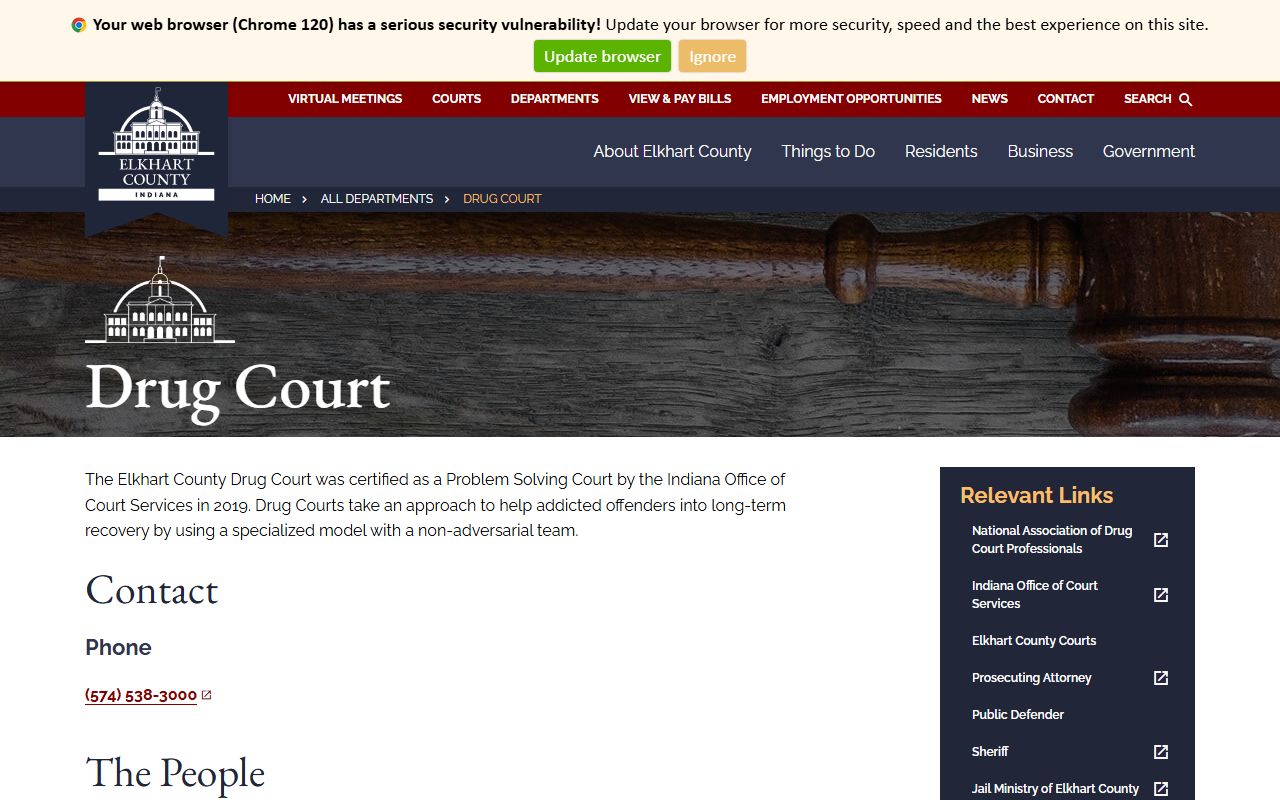
Specialty court participation does not erase a charge by itself; the court record should still be checked for disposition and sentence details.
Elkhart County Charge Status
A filed charge can change as the case moves. A prosecutor may amend a charge, add a new count, reduce a count during plea discussions, or dismiss a count. The court may later enter a judgment, sentence, deferral result, dismissal, or other disposition. A charge line is not the same as a conviction line.
| Status | Meaning |
|---|---|
| Pending | The charge is open and no final public disposition is shown yet. |
| Amended or reduced | The filed count changed, often by statute, degree, description, or severity. |
| Dismissed | The charge or case was ended without a conviction on that count, subject to the exact order. |
| Conviction | The court entered a judgment of guilt after plea, finding, or verdict. |
| Expunged or sealed | Public access is restricted by statute, rule, or court order. |
Charges vs Convictions
A charge is an accusation filed in court. A conviction is a final finding or judgment of guilt. Elkhart County MyCase records may show both, but the reader has to review the event history and disposition rather than stopping at the first charge line. A dismissed charge, amended charge, pending charge, and conviction have different meanings.
| Question | Charge | Conviction |
|---|---|---|
| What is it? | An allegation filed after arrest, citation, or prosecutor review. | A court outcome showing guilt on a count. |
| Where appears? | Charge section, docket events, citation details, and charging documents. | Disposition, judgment, sentencing, and criminal history entries when public. |
| Can it change? | Yes. It may be amended, reduced, dropped, or dismissed. | It may later be appealed, corrected, sealed, or expunged if eligible. |
Note: Use the final disposition and sentence entries before treating a filed charge as a finished case outcome.
Charge Codes and Severity
MyCase charge details can include a statute, degree, offense date, citation number, and offense modification. Indiana criminal cases may involve felony or misdemeanor charges, while traffic matters may involve infractions. One arrest can produce several charges, and one case can include charges with different outcomes.
Indiana juvenile records are treated differently. Indiana Code 31-39 includes confidentiality rules for juvenile court and law-enforcement records, and public court access can be limited. The Indiana juvenile records statutes are important when an allegation involves a minor.
Juvenile confidentiality is one reason a charge or arrest event may not appear in a public search result.
Restricted Elkhart County Charge Records
Public access is limited for juvenile matters, adoption-related records, protected-person data in protection orders, sealed cases, expunged cases, and confidential personal information. The Indiana Rules on Access to Court Records and the Rule 10 excluded-record list control many public access limits. Indiana Code 35-38-9 governs many sealing and expungement paths for qualifying arrest, charge, juvenile allegation, and conviction records.
The Elkhart County Access to Justice Center links expungement form sets for conviction and non-conviction records. Those forms include appearances, petitions, notices of exclusion, confidential forms, proposed orders, and exhibits for extra cases or arrests. Eligibility should not be assumed from a search result. A court order controls whether the record is restricted.
Elkhart County Charge Access Limits
Elkhart County arrest records can be split across agencies. The sheriff may hold a booking record, incident report, crash report, limited criminal history report, or jail custody entry. The clerk and court hold the filed charge, docket, disposition, judgment, sentence, and certified court copy. The prosecutor may explain charging programs or diversion paths, but the prosecutor's office is not the public court-record counter. That split is why a MyCase search, sheriff records request, and clerk copy request can return different pieces of the same arrest-to-charge history.
Older cases, city court cases, and restricted cases need extra care. MyCase help says older cases may not be online. City citations or local ordinance matters may require Elkhart City Court, Goshen City Court, or Nappanee City Court follow-up if the statewide search does not show the record. A missing online charge does not prove no charge exists. It can mean the case is older, sealed, expunged, juvenile, held by a city court, or not yet filed in court after an arrest.
Elkhart County Charge Record Contacts
Use the office tied to the record type. For filed charges, case numbers, court dates, dispositions, and certified court copies, use the Elkhart County Clerk. For booking, jail custody, sheriff reports, limited criminal history reports, and public-record requests to law enforcement, use the Sheriff's Office. For prosecutor programs, charging-office context, and diversion or deferral references, use the Elkhart County Prosecuting Attorney.
Elkhart County Clerk
1905 Reliance Road
Goshen, IN 46526
574-538-3000
Use for court charges, dispositions, and certified court copies.
Elkhart County Sheriff's Office
26861 County Road 26
Elkhart, IN 46517
574-891-2100
Use for booking, custody, sheriff records, and limited criminal history reports.
Elkhart County Prosecuting Attorney
301 S. Main St., Suite 100
Elkhart, IN 46516
574-296-1888
Use for prosecutor office programs and charging-office context.
Elkhart County Background Checks
MyCase is not a complete criminal-history report. It is a court-record search. The sheriff's limited criminal history report, Indiana State Police criminal history services, and formal background-check systems serve different purposes. For sheriff records, the research found fees of $3 for a criminal incident report, $3 for a limited criminal history report, $12 for a crash report, and $10 for a fingerprint card.
Neither online court data nor third-party search results should be used for employment, tenant screening, insurance, credit, or other FCRA-regulated decisions unless the provider is legally authorized for that purpose. Certified court copies must come from the court or clerk. Law-enforcement reports must come from the sheriff or the agency that holds the report.